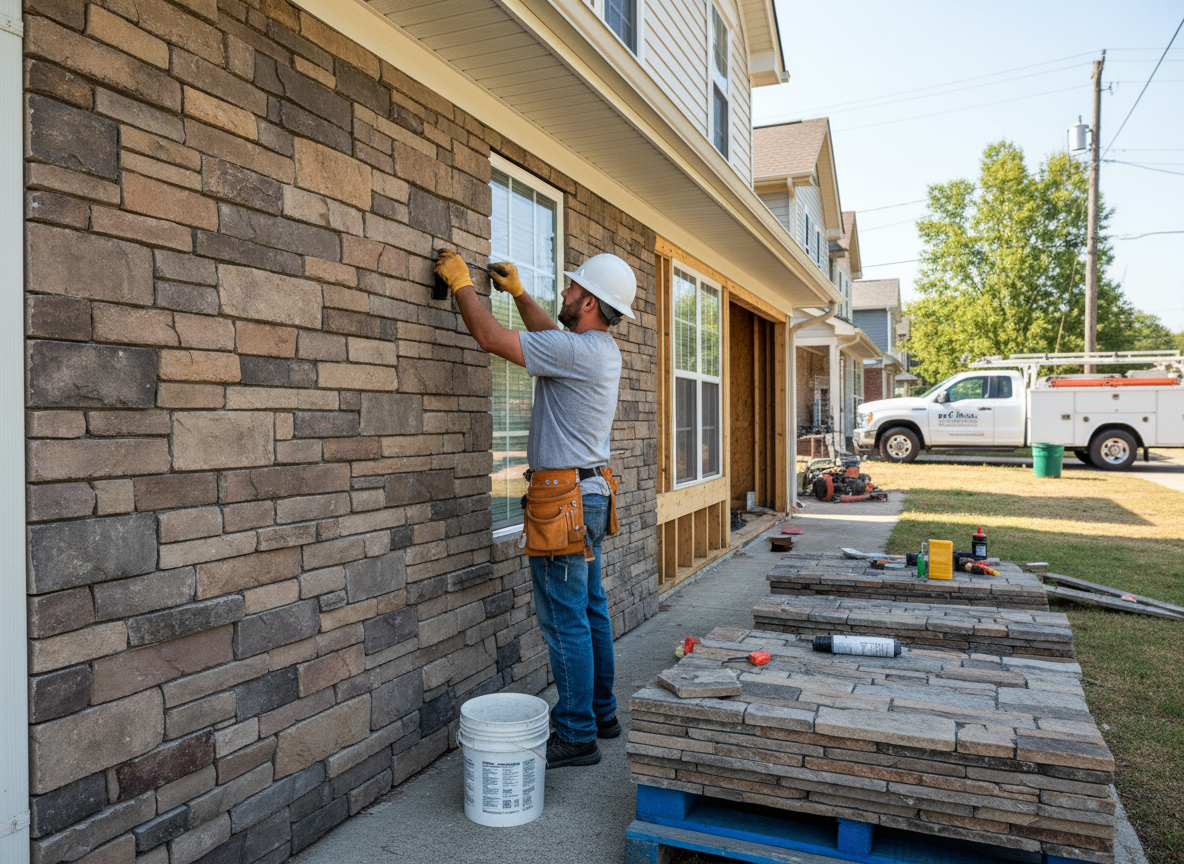
Fake rock siding, also called manufactured stone veneer, requires precise substrate prep to avoid moisture intrusion behind the panels. In Montgomery, many homes from the mid-20th century have wood sheathing or older brick that must be evaluated for rot or settling before any new veneer is applied. Proper weep holes, flashing at windows, and a minimum 3/8-inch air gap behind the stone are non-negotiable to handle the region's freeze-thaw cycles and occasional heavy spring rains.
Homeowners often overlook how soil movement along the Little Miami River corridor can shift foundations slightly over decades, creating hairline cracks that propagate into the siding system. Voltiva Systems checks grade and drainage first, then installs a moisture barrier rated for the local humidity swings. Corner pieces and keystones are hand-selected on site to maintain a natural stacked-stone appearance rather than a repeating pattern that stands out on Montgomery streets.
Edge cases include attaching the system to insulated concrete forms on newer builds or matching the profile on additions where the original siding has faded differently. We use corrosion-resistant fasteners rated for exterior use and test pull-out strength on every wall section. This prevents the common failure where lightweight panels loosen after several winters of expansion and contraction.
Technician insight
In Montgomery, the thing that catches most people out with fake rock siding is how the clay-heavy soil and older raised foundations shift just enough each winter to crack mortar joints if the weep system and expansion gaps aren't detailed right on the first install.
Older Montgomery Home Addition
The addition on a 1960s Montgomery house showed water staining at the base after two winters. We found missing flashing where the new veneer met the original brick. We removed the lower course, added proper step flashing and a drainage plane, then reinstalled matching panels. No further staining appeared the following spring.
How it works
- 1
Site Assessment
We examine existing siding, substrate condition, drainage, and any foundation movement specific to the Montgomery property.
- 2
Material Selection
Homeowner chooses profile and color; we confirm quantities and corner treatments on site.
- 3
Substrate Prep
Installation of weather barrier, flashing, and lath or direct-mount system as required by the wall type.
- 4
Panel Installation
Fake rock panels are set with mortar or mechanical fasteners, joints tooled, and final sealing applied.
- 5
Final Walkthrough
We inspect drainage, adhesion, and appearance together before cleanup.
Pricing
Pricing depends on wall area, existing substrate condition, and chosen stone profile; we provide upfront written quotes after the site visit.